
The figure that catches the eye
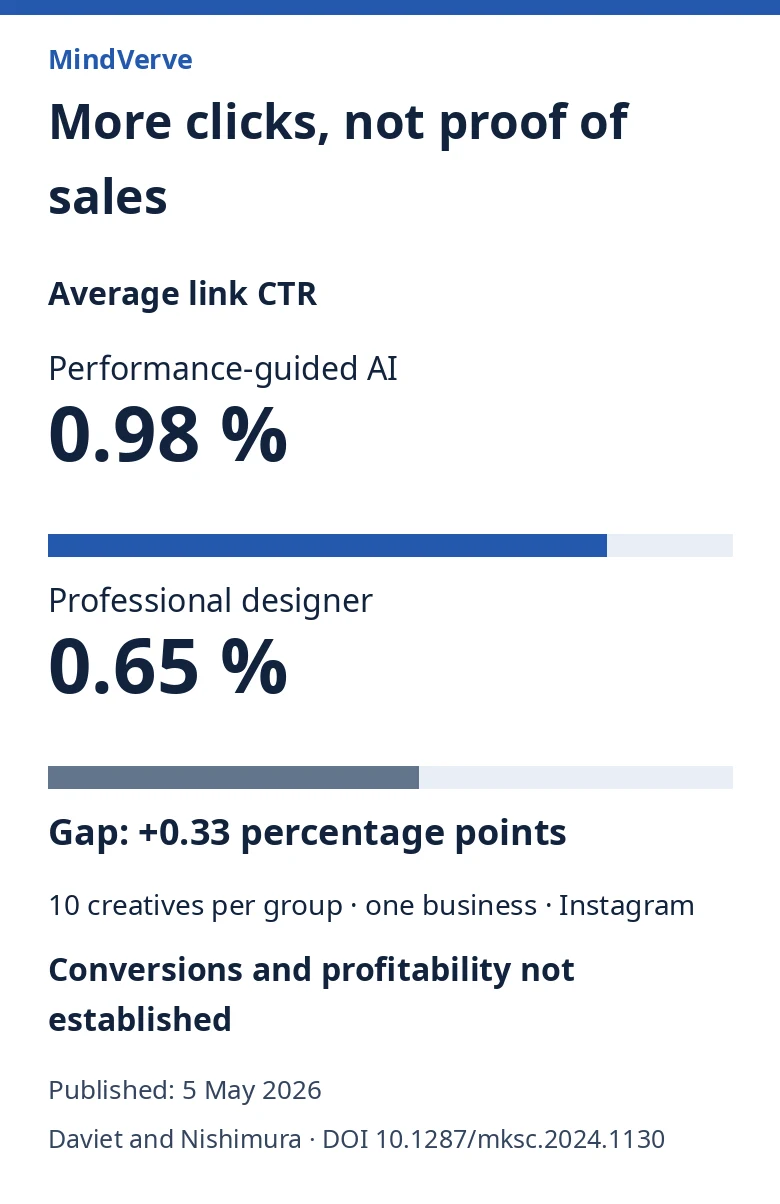
Daviet and Nishimura, writing in Marketing Science (published online on 5 May 2026), study Instagram ad backgrounds for an outdoor activities business. Following training, three groups of ten ad creatives are compared over one week: performance-guided AI, AI optimised for aesthetics, and work by a professional designer. Average link CTR reaches 0.98%, 0.78% and 0.65%, respectively.
The gap between performance-guided AI and the designer is therefore 0.33 percentage points, or approximately 51% relative to the designer’s rate. That does not mean 51% more customers. CTR measures clicks as a proportion of ad impressions; here, the figures are averages across creatives.
Daviet and Nishimura, Marketing Science, 2026, Tables 2 and 3; checked on 1 November 2026.Interesting evidence, not a universal victory
The study covers one business and a single benchmark designer. The authors do not isolate a pure causal effect: the platform plays a role in distributing the ads. In the second test, the averages of 3.38% versus 3.24% do not represent a statistically demonstrated advantage (one-sided p = 0.323). These comparisons establish no increase in sales or margin.
That does not make the experiment useless. It changes the decision to draw from it: consider an avenue to assess in your own context, rather than replace a team or increase a budget on the strength of a single percentage.
Daviet and Nishimura, Marketing Science, 2026, Tables 2 and 3; checked on 1 November 2026.What a small business can take away without buying a promise
Choosing an ad creative should take into account its message, its fit with the brand and what the business actually wants to achieve after the click. An appealing image may attract an audience that is not relevant. A lower production cost is not enough either if approvals, revisions or media buying absorb the saving.
Our reading: the first useful investment is in defining the scope. What problem are you trying to solve? What business outcome would be meaningful enough? What data would show whether it had been achieved? These decisions help avoid confusing a visual demonstration with a profitable project.
The limitations stay in view
The country and total impressions for the comparison are not explicitly established in the passages checked. The published timeline of the second test contains an inconsistency, so we draw no promises about duration from it. The figures presented are neither MindVerve results nor a forecast for your business.
Daviet and Nishimura, Marketing Science, 2026, Tables 2 and 3; checked on 1 November 2026.The MindVerve diagnostic can help prioritise a use case and define the criteria for an initial pilot. Running the pilot, managing advertising and publishing are not included in this scoping work. Let’s discuss your needs before deciding what to test.
Define the scope of an AI opportunity