
A specific intervention, not a comparison of every writing method
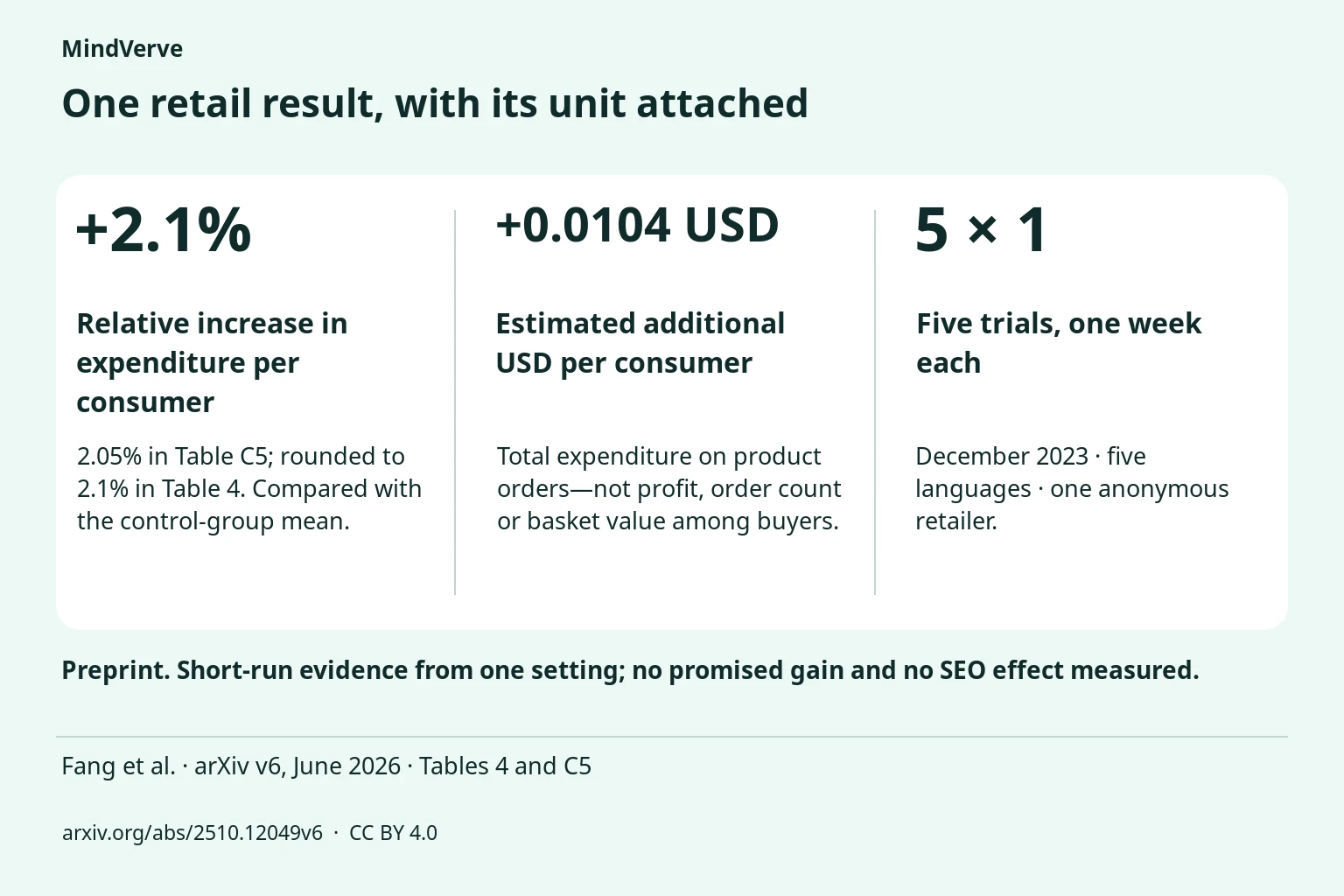
At one anonymous cross-border retailer, five randomised trials ran for one week each in December 2023. They covered English, Spanish, French, Portuguese and Korean. Consumers entered after clicking selected product-detail pages; the analysis contains 4,772,937 consumer observations, not 4.77 million buyers or a census of all visitors.
The treatment added AI descriptions alongside the existing human-written descriptions; where no description existed, it supplied one. The control group retained the initial situation. This tests that intervention in that setting. It does not establish that an AI description beats a well-researched, carefully edited description for every product.
Read the primary study and its product-description resultsThe unit is expenditure per consumer
The estimated increase was USD 0.0104 per consumer. Relative to the control-group mean, Appendix Table C5 reports 2.05%; the main table rounds this to 2.1%. The outcome is total expenditure on product orders, measured in USD at consumer level. It is not a 2.1-percentage-point increase in conversion, a count of additional orders or the average basket of people who purchased.
The reported standard error is USD 0.00417 and the effect is statistically significant at the 5% level. Statistical significance does not tell you whether a similar intervention would cover your editorial, review and integration costs. Profit and implementation return are separate questions.
Read the primary study and its product-description resultsWhat was missing before AI arrived?
Nearly half of the retailer’s self-sold products had absent or minimal descriptions. That context makes the initial information gap worth examining before commissioning a rewrite. It does not prove a universal mechanism or show that every short page should receive more words.
The English-only analysis comparing shorter and longer descriptions does not establish a difference between their relative effects at the 5% threshold: the reported comparison has p = 0.0536. A significant estimate in one subgroup and a non-significant estimate in another is not, by itself, evidence that the two effects differ. Do not turn a description-length cutoff into a commercial rule.
Read the primary study and its product-description resultsThree questions before expanding the catalogue
First, which verified product facts are customers missing? A claim about suitability, material or compatibility needs an accountable source. Second, does the information address the audience and language actually being served? Localisation is not a promise of availability in a new market. Third, which business outcome would justify the effort, with review and operating costs included? These questions define a useful brief; a target number of generated descriptions does not.
MindVerve’s interpretation is to distinguish information quality from production volume. Improving a genuine gap may be a sensible candidate for scoped work, but the study’s percentage should not become your budget forecast or acceptance target.
Evidence to consider, not a result to promise
This is a preprint, version 6 revised in June 2026, reporting short trials from 2023 at one retailer. It is not a benchmark of current models, a study of SEO or AI-search citations, or a forecast for smaller businesses. The authors disclose that Fang and Yuan consulted for the partner and Zhang was an employee. Those relationships belong alongside the findings, not outside the reader’s view.
Read the primary study and its product-description resultsMindVerve can help clarify the product-information gap, editorial priorities and review requirements within its existing AI content and campaign services. Catalogue integration or commercial experimentation needs an agreed scope; neither the study’s uplift nor a particular sales result is promised.
Discuss a bounded content projectOfficial sources
Independent MindVerve analysis of Fang, Yuan, Zhang, Donati and Sarvary, Generative AI and Sales Productivity: Field Experiments in Online Retail, arXiv:2510.12049v6. Original evidence card adapted from reported data, not a reproduction of a paper figure. Source licence: CC BY 4.0. MindVerve did not run these experiments.
Read the primary study and its product-description resultsGenerative AI and Sales Productivity: Field Experiments in Online Retail · Fang, Yuan, Zhang, Donati, Sarvary · arXiv:2510.12049v6CC BY 4.0